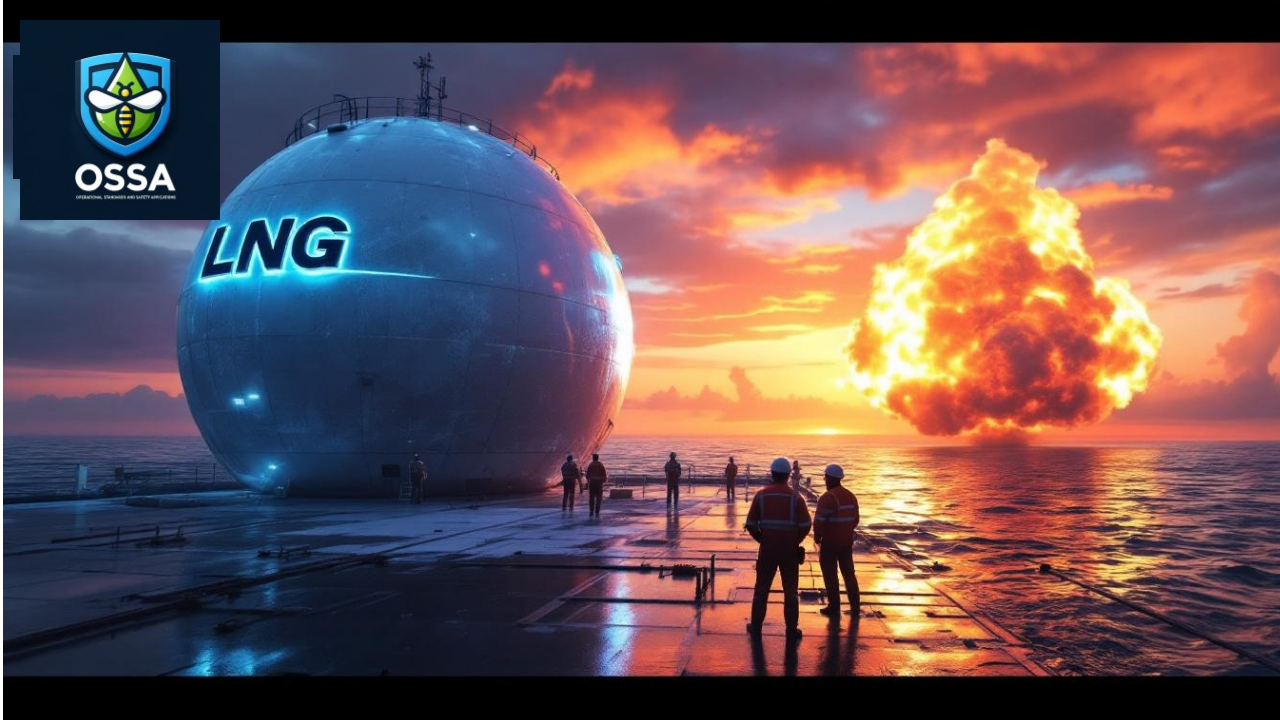
The Beirut port explosion: I remember sitting at my cluttered kitchen table, transfixed by news footage rolling on repeat. My mug of tea went cold as I tried to wrap my head around the wall of shattered glass and unspeakable loss—an event so violent and unexpected it made me think about the silent threats nestled in the heart of our cities. One word kept echoing: LNG. That night, I found myself wondering—are we living next door to a bomb we barely understand, or does the reality behind those massive ships offer a different story? (podcast)
The Myth and Mathematics: Is an LNG Ship Really a ‘Tamed Bomb’?
Where the ‘Tamed Bomb’ Analogy Comes From
The phrase “tamed bomb” gets tossed around a lot when people talk about LNG carriers. It’s easy to see why: these ships are truly massive, and the numbers behind their cargo are staggering. Each LNG ship typically carries around 174,000 cubic meters of liquefied natural gas, stored at an ultra-cold -162°C. That’s about 78,300,000 kilograms of LNG—roughly 78.3 kilotons. When you look at the LNG energy content, it’s natural to feel a sense of awe, or even unease.
Crunching the Numbers: LNG Energy Content vs. Hiroshima
Let’s break down the math. Methane, the main component of LNG, has a lower heating value (LHV) of about 50 megajoules per kilogram. Multiply that by the total mass on a typical LNG carrier, and you get a chemical energy content of roughly 3.9 petajoules (PJ). For context, the atomic bomb dropped on Hiroshima released about 63 terajoules (TJ) of energy. That means a single LNG ship holds the chemical energy equivalent of about 62 Hiroshima bombs (3,915 TJ vs. 63 TJ).
On paper, these numbers are jaw-dropping. It’s no wonder the “tamed bomb” label sticks in people’s minds. But here’s where the analogy starts to fall apart.
Why Raw Energy Content Doesn’t Equal Bomb-Like Danger
The comparison between an LNG ship and a nuclear bomb is based solely on the total LNG energy content. But the real risk comes not from how much energy is present, but how that energy is released. As one expert put it:
“You simply cannot equate the two based on raw energy alone. The physics are totally different.”
A nuclear detonation or a high-explosive event like the Beirut ammonium nitrate blast releases energy almost instantaneously, creating a supersonic shock wave and catastrophic overpressure. In contrast, LNG cannot physically detonate like a bomb. The mechanisms are fundamentally different.
LNG Deflagration vs. Detonation: The Crucial Difference
Understanding LNG deflagration vs detonation is key to grasping LNG safety. If LNG is released, it rapidly vaporizes into a cold, dense methane cloud. For ignition to occur, the methane concentration in air must be between about 5% and 15% (the lower and upper explosive limits). If a spark finds this cloud within those limits, the most likely outcome is a deflagration—a fast, but subsonic, burn. This is very different from a detonation, which is a supersonic, high-pressure explosion.
In practice, LNG vapor cloud explosions (VCEs) are rare and, when they do occur, the resulting overpressure is much lower and more dispersed than in a true detonation. Most incidents result in intense heat (pool fires or jet fires), not catastrophic blast waves. This is a fundamentally different hazard profile compared to high explosives or nuclear materials.
Why the ‘Tamed Bomb’ Analogy is Misleading
Release Rate: LNG energy is released slowly (by burning), not instantaneously (by detonation).
Mechanism: LNG burns via deflagration, not detonation. There is no supersonic shock wave.
Physical Properties: Methane vapor disperses quickly and becomes lighter than air, reducing the risk of large-scale explosions.
Safety Systems: Modern LNG facility safety relies on multiple engineering and operational layers to prevent and manage leaks or fires.
Bottom Line: Energy Content Isn’t the Whole Story
The “tamed bomb” analogy for LNG ships is rooted in the raw numbers, but it ignores the science of how energy is actually released. LNG safety is not about the total energy stored, but about the mechanisms of release and the robust systems in place to prevent catastrophic events. While the energy content is massive, LNG simply does not behave like a bomb—because the physics make that impossible.
How LNG Really Behaves: Fire, Vapor, and Urban Myth-Busting
Physical Behavior of LNG Spills: Rapid Vaporization and Cold Vapor Clouds
When liquefied natural gas (LNG) is accidentally released, its behavior is strikingly different from what many imagine. LNG is stored at an extremely cold temperature—about -162°C. The moment it contacts a warmer surface, whether water or land, it doesn’t pool for long. Instead, it rapidly vaporizes, forming a dense, cold cloud of methane vapor that initially hugs the ground. This is the first step in understanding LNG Spill Management: the liquid doesn’t linger, and the risk profile shifts almost immediately from liquid hazards to vapor hazards.
Strict Flammability: The Narrow Window for Ignition
A key fact about LNG is its strict flammability limits. Methane, the main component of LNG, will only ignite if its concentration in air is between 5% (the Lower Explosive Limit, or LEL) and 15% (the Upper Explosive Limit, or UEL). Outside this narrow range, there’s no risk of ignition. If the vapor cloud is too diluted or too concentrated, it simply won’t burn. This sharply limits the scenarios where fire can occur, making LNG Facility Safety a matter of controlling vapor dispersion and monitoring concentrations.
Deflagration vs. Explosion: Why LNG Doesn’t Behave Like a Bomb
One of the most persistent urban myths is that an LNG spill could cause a massive, catastrophic explosion—something akin to the Beirut blast or a munitions disaster. This is simply not how LNG behaves. As experts emphasize:
"LNG does not detonate in the manner of ammonium nitrate or a high explosive. It behaves completely differently."
If LNG vapor ignites within its flammable range, the result is almost always a deflagration—a rapid, but subsonic, burning. This produces intense heat and visible flames, but not the supersonic shockwave associated with a true detonation. In most real-world incidents, the outcome is a localized pool fire (if liquid remains) or a jet fire (if under pressure), not a blast.
Understanding Vapor Cloud Explosions (VCEs): Rare and Subdetonative
So what about LNG Vapor Cloud Explosion Risks? Vapor cloud explosions (VCEs) can occur if a large, flammable cloud forms and finds an ignition source in a confined or congested area. However, even in these rare cases, the flame front travels at subsonic speeds—meaning the overpressure is much lower than in high-order detonations. For context:
Window breakage: ~0.1 bar overpressure
Structural damage: ~0.3–0.5 bar overpressure
High explosives (like Beirut): produce peak pressures many times higher, almost instantaneously
Methane VCEs are dangerous, but they are fundamentally less destructive than detonations caused by ammonium nitrate or munitions. The energy is released more slowly and over a wider area—more of a forceful push than a shattering blow.
Comparisons with Historic Disasters: Why LNG Risks Are Unique
It’s natural to draw comparisons to infamous port disasters—Beirut (2020), Halifax (1917), Texas City (1947)—where stored energy was released in devastating detonations. But these events involved materials like ammonium nitrate or munitions, which can transition from burning (deflagration) to true detonation under the right conditions. LNG, by contrast, lacks the chemical properties and confinement needed for detonation. Its hazards are real, but they are fire risks rather than explosive risks.
In summary, LNG’s behavior is governed by rapid vaporization, strict flammability limits, and a tendency to burn rather than explode. Most incidents result in fire, not catastrophic blasts. Subdetonative vapor cloud explosions are possible but rare, and much less violent than popular fears suggest. This distinction is critical for understanding LNG Deflagration vs Detonation and for separating fact from urban myth in discussions of LNG Facility Safety.
Layers of Protection: The Real Safety Nets on LNG Carriers (And a Day They Were Tested)
When we talk about LNG safety systems, it’s easy to get lost in the numbers—the staggering energy stored on a single LNG carrier, the chilling -162°C temperature of the cargo, or the fact that a ship might carry the energy equivalent of dozens of Hiroshima bombs. But the real story of LNG safety isn’t about raw potential; it’s about the layers of engineering, protocols, and training that keep that potential firmly under control. The truth is, LNG carrier engineering controls are some of the most advanced in the shipping world, and the way they’re operated is a lesson in methodical, layered safety.
Let’s start with the hardware. Every LNG carrier is built around double-containment cargo tanks—either membrane or spherical “Moss” types—designed to keep the super-cold methane securely inside. If the primary barrier fails, a secondary barrier stands ready. These tanks are wrapped in robust insulation, using specialized materials like nickel alloys and stainless steel, because ordinary steel would shatter at -162°C. This is engineering redundancy at its finest: every critical system has a backup, and sometimes a backup for the backup.
But containment is only the first layer. The next is detection. LNG ships are studded with gas detectors, constantly sniffing for methane at levels far below the 5% lower explosive limit (LEL). If even a trace is detected, alarms sound—early warning is everything. Around the tanks, inert gas systems (usually nitrogen) keep the atmosphere non-flammable, so even if a leak occurs, there’s no oxygen to support combustion. And if something does go wrong, LNG emergency shutdown devices (ESD) can instantly isolate sections of the system, stop pumps, and vent gas safely away from the ship and crew. These systems are designed to fail safe: if power or control is lost, they default to the safest possible state.
Of course, hardware is only half the story. LNG facility operations are governed by strict international codes, like the IMO’s IGC Code and the ISPS security framework, as well as best practices from industry groups like SIGTTO. Local port authorities add their own rules—daylight-only movements, mandatory tug escorts, exclusion zones, and more. Every step is regulated, rehearsed, and reinforced by relentless training. LNG facility operator training is continuous, with regular drills that simulate everything from minor leaks to full-scale emergencies. Everyone on board knows their role, and everyone practices it until it’s second nature.
To see how these layers work together, imagine a real-world scenario. Picture a ship—let’s call her the PolarStar—creeping into port on a foggy morning. A junior engineer hears a faint hiss near a pressure relief valve on tank three. There’s no panic. The bridge is notified, escort tugs confirm the exclusion zone, and the crew dons breathing apparatus to investigate. Portable detectors show a small, localized methane concentration—well below the ignition threshold, but enough to trigger action. The chief engineer manages the tank pressure, the ESD system stands ready, and ventilation is boosted. No one improvises; everyone follows the protocol. Within minutes, the leak is isolated, the concentration drops, and the ship continues safely. As I often say, “That whole sequence—that’s not luck. That’s the system working exactly as designed.”
What stands out in LNG safety is not just the sophistication of the technology, but the culture of anticipation. Every possible failure is imagined in advance, and the response is layered: from human vigilance, to engineering controls, to all-hands emergency drills. LNG carrier engineering controls and LNG emergency shutdown devices are only as effective as the people who operate them, and that’s why crew training is relentless. The result is a system where glitches are handled calmly, methodically, and with multiple checks at every stage.
In the end, the odd truth beneath the surface is this: while the energy on an LNG carrier is immense, the real safety net is the sum of its layers—robust hardware, strict protocols, and constant readiness. These ships are among the most risk-managed vessels afloat, not because accidents never happen, but because every layer is designed to catch a problem before it becomes a disaster. That’s the reassuring reality of LNG safety.
TL;DR: LNG ships may seem intimidating, but robust design, strict international rules, cutting-edge safety systems, and relentless training mean the risk is more managed than you might think. While lessons from disasters push us to remain vigilant, LNG carriers are built with redundancy on redundancy—and it works.
Comments
Post a Comment